
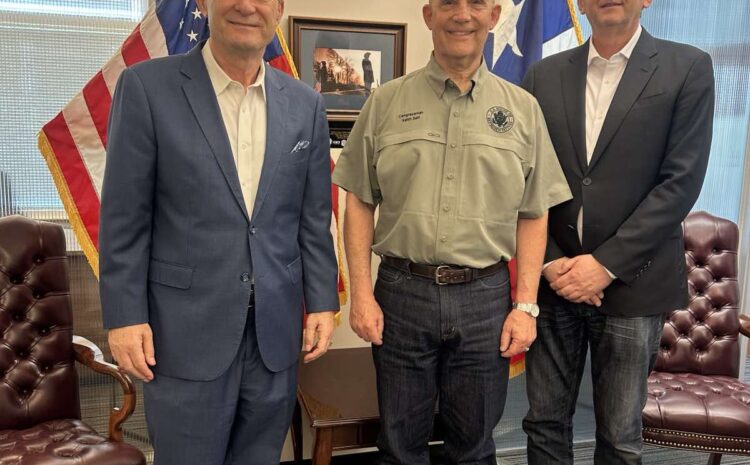
The Albanian American Organization for North Macedonia (AAOFNM) and Albanians for America (AFA) held a productive meeting with Congressman Keith Self, Chairman of the Subcommittee on Europe, to discuss ongoing challenges facing Albanians in North Macedonia and the incomplete implementation of the Ohrid Framework Agreement.
The discussion focused on what participants described as the “unfinished promise” of the Ohrid Agreement and its continued importance to U.S. foreign policy. While the Agreement successfully ended the 2001 conflict and laid the foundation for a multi-ethnic democracy, participants emphasized that key provisions remain only partially implemented.
Vullnet Dervishi of the Albanian American Organization for North Macedonia stressed that more than two decades after the Ohrid Framework Agreement ended the conflict, it remains an unfinished project. While it successfully halted violence and established a framework for a multi-ethnic democracy, its incomplete implementation continues to pose risks to stability, democratic development, and Western alignment in the Balkans. He highlighted several critical areas of concern, including equitable representation, language equality, decentralization, institutional equality, and rule of law.
Recent developments further illustrate these concerns. These include constitutional violations related to the use of the Albanian language, such as restrictions on taking the final jurisprudence exam in Albanian, as well as official notifications, such as those related to the “Safe City” project, being issued only in Macedonian and English, but not in Albanian.
Bruno Ceka of the Albanian American Organization noted that recent developments surrounding Corridor 8 represent another deviation from proper implementation. He emphasized that such actions risk diverting attention and may provoke further non-compliance, particularly given the project’s direct importance to the economic development of Albanian-populated regions in North Macedonia.
Representatives of Albanians for America, including Gino Mulliqi and Doc Vranici, agreed that U.S. engagement should shift from viewing the Ohrid Framework Agreement as a completed success to supporting it as an ongoing process. This approach should prioritize institutional equality, strengthen accountability, and ensure that minority protections are implemented in practice, not merely on paper.
In conclusion, Mr. Dervishi emphasized that future discussions should focus on redistributing power from the central government to regions and municipalities, with protections guaranteed by the constitution. Such a shift, he noted, may require moving from a unitary system to a more suitable model that ensures genuine equality, including forms of federalism.